

Published: October 31, 2020 · Updated: September 22, 2026
Quick answer: A healthy adult angelfish can usually handle several days without food, and around a week may be manageable in a stable tank. However, surviving a long fast is not the same as it being safe. Angelfish research has found physiological effects and increasing deaths during prolonged fasting, so a two-week fast should not be treated as planned care. Fry, juveniles, sick, or underweight fish should not be intentionally fasted.
How Long Can Angelfish Go Without Food?
A healthy adult angelfish can usually tolerate several days without food, and around a week may be manageable in a stable, well-run aquarium. But a week is not a guaranteed safe limit, and intentionally leaving an angelfish unfed for two weeks is not recommended. Fry, juveniles, and any sick, underweight, or recovering fish need much more regular feeding.
It helps to separate two things that often get blurred together: how long an angelfish can survive without food, and how long it is reasonable to leave one unfed on purpose. Survival is possible for longer than many owners expect — fish are cold-blooded and burn energy slowly — but longer fasts carry real physiological costs. For a healthy, well-conditioned adult in a stable aquarium, missing food for two or three days is generally far less concerning than a prolonged fast.
What Research Says About Angelfish Fasting
Most “how long can a fish go without food” advice online is guesswork, but there is a study specific to angelfish. Motta and colleagues (2021) fasted juvenile Pterophyllum scalare for 0, 3, 6, 9, 12, and 15 days and tracked the effects. The short version: the fish could survive surprisingly long fasts, but not without cost.
| Fasting duration | What the study observed (juvenile angelfish) |
|---|---|
| 0–3 days | Short fasting used as mild/baseline treatments. |
| 6–9 days | Fish drew on liver energy reserves; physiological changes became relevant, and deaths began to appear (around day 8). |
| 12–15 days | Stronger liver and intestine effects; mortality increased. The 15-day group had roughly 86.5% survival during the fast, and the authors cautioned that fasting beyond this could be fatal at this life stage. |
The key takeaway is one of interpretation. The study shows that prolonged survival is possible, but it also documents that the fish burned through liver energy reserves, developed organ-level effects, and died in growing numbers as the fast dragged on. “Can survive” is not the same as “is safe” or “is a good idea.” These are experimental results in young fish, not a home-aquarium target — do not read them as permission to leave your angelfish unfed for two weeks.
Adult vs. Juvenile Angelfish
Life stage is one of the most important factors in fasting tolerance — but not the only one. A full-grown, well-conditioned adult has the reserves to ride out several days. Young angelfish are different: they are actively growing, so regular feeding matters far more for them than for a healthy adult. The 2021 study above used juveniles and did record survival through longer fasts, but with rising physiological costs and mortality — so “they can survive a missed meal” is true, while “you can safely fast a growing juvenile like an adult” is not. If your tank holds fry or juveniles, plan for consistent feeding.
What Affects How Long an Angelfish Can Go Without Food?
There is no single number, because fasting tolerance depends on several things at once:
- Age and life stage — adults cope far better than growing juveniles or fry.
- Health and body condition — a robust, well-fed fish has reserves that a thin, sick, or recovering fish does not.
- Water temperature — warmer water raises metabolism and shortens the safe window.
- Recent feeding history — a fish that has been well fed going in tolerates a fast better.
- Stress and aquarium conditions — stable, clean, low-stress tanks make a fast easier to weather.
How Often Should You Feed Angelfish?
Feed angelfish small amounts on a schedule that suits their life stage — more often when young, less often as adults.
| Life stage | Practical feeding guidance |
|---|---|
| Fry / post-larvae | Frequent small, appropriate meals; do not intentionally fast. |
| Growing juveniles | Usually at least 2 small feedings a day. |
| Healthy adults | Usually 1–2 small feedings a day. |
Aquaculture research supports frequent small feedings for young fish: a first-feeding study (Eiras et al., 2022) found angelfish post-larvae did well when their ration was divided into two daily feedings, and earlier work on juvenile angelfish recommended at least two meals a day under the tested conditions. Treat these as guidance, not rigid rules — the right frequency depends on the food, the fish’s condition, and its life stage. A useful habit is to feed only what the fish finish in a couple of minutes and remove leftovers. A healthy adult can tolerate the occasional missed meal, but there is no need to schedule a weekly “fasting day” unless you have a specific husbandry reason, and it is generally safer to slightly underfeed than to overfeed, since excess food fouls the water.
What Should Angelfish Eat?
Angelfish are omnivorous, with a strong natural tendency toward small aquatic invertebrate prey — in the wild, Pterophyllum scalare feeds predominantly on zoobenthos such as small crustaceans and other aquatic invertebrates. In the aquarium, build their diet around a few staples:
- Quality flakes or pellets made for angelfish or cichlids, as the everyday base.
- Frozen or freeze-dried foods such as brine shrimp, daphnia, and bloodworms, a few times a week for variety.
- Live foods like brine shrimp or daphnia as an occasional treat — from a clean, reputable source, since live food can carry parasites or bacteria.
- The occasional blanched vegetable for a little variety.
One thing to avoid is routinely using feeder guppies or other feeder fish: they can introduce disease and parasites, offer inconsistent nutrition, and are unnecessary for normal angelfish care. A varied diet of prepared and aquatic-invertebrate foods covers their needs.
What If You Run Out of Fish Food?
If you have simply run out and cannot restock for a day or two, the safest option for a healthy adult angelfish is usually a short fast — a couple of unfed days will not harm it, and that is better than experimenting with unsuitable human foods. If you want to offer a small stopgap, a little blanched vegetable is reasonable, but do not treat vegetables as a complete diet, and remove anything uneaten. When in doubt, a brief wait for proper food beats a bad substitute.
How to Feed Angelfish While You’re on Vacation
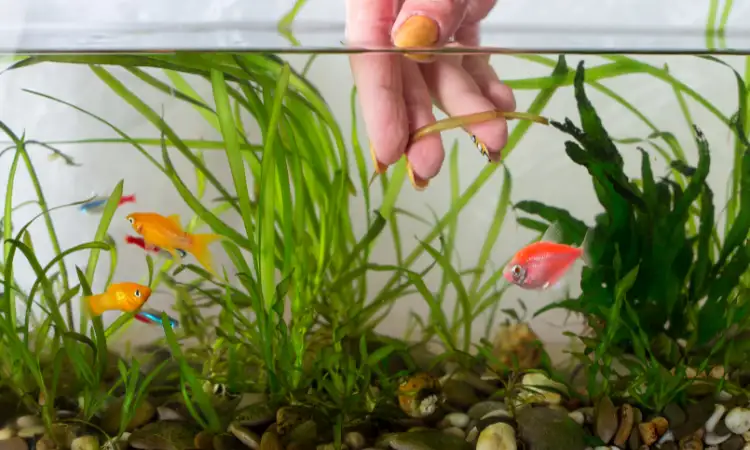
For a short weekend of roughly two to three days, a healthy adult angelfish is generally fine with no feeding at all — just feed again when you get back. For longer trips, use one of two reliable approaches:
- A properly tested automatic feeder — a programmable device that dispenses dry food on a timer. Test it for several days before you leave to confirm it works and dispenses an appropriate amount, and set it to the minimum your fish need.
- A trusted tank-sitter using pre-measured portions — a pill organiser with one compartment per feeding prevents overfeeding, and a sitter can also notice if something looks wrong.
Handle maintenance a day or two before you leave, not on the way out the door. Aquarium Co-Op recommends completing normal maintenance around 48 hours ahead so you have time to confirm the filter restarted, the heater and equipment are working, and the fish are behaving normally — rather than discovering a problem after you have gone. Avoid unusually large cleans or filter-media swaps right before a trip.
A note on vacation feeder blocks: they are convenient, but they can dissolve unpredictably, go uneaten, and contribute to poor water quality — Aquarium Co-Op notes they tend to cause ammonia spikes and algae blooms because they break into particles larger fish cannot eat. A tested automatic feeder or pre-measured sitter portions are generally more controllable.
Frequently Asked Questions
How long can an angelfish survive without food?
A healthy adult angelfish can usually manage several days, and around a week may be tolerable under good conditions — but that is not a guaranteed safe limit. Angelfish research recorded survival through longer fasts alongside physiological effects and rising mortality, so a two-week fast should not be planned. Fry and juveniles need regular feeding.
Can I leave my angelfish for a weekend without feeding?
Yes. A healthy adult angelfish is generally fine over a two- or three-day weekend with no food. Do your normal maintenance a day or two beforehand and feed as usual when you return.
Is a week without food safe for an angelfish?
Around a week may be manageable for a healthy adult in a stable tank, but “survivable” is not the same as “safe.” For any trip near or beyond a week, use a tested automatic feeder or a tank-sitter rather than relying on the fish to fast.
Should I use a vacation feeder block for my angelfish?
It’s best avoided when you have a better option. Feeder blocks can dissolve unpredictably, go uneaten, and worsen water quality. An automatic feeder or a tank-sitter with pre-measured portions is more reliable.
How often should I feed baby angelfish?
Frequently — small, appropriate meals through the day, and never an intentional fast. Fry and juveniles are actively growing, so regular feeding matters far more for them than for a healthy adult.
Is it better to underfeed or overfeed angelfish?
Slightly underfeed. Angelfish handle a missed meal easily, whereas excess food rots and spikes ammonia, which is a far bigger threat. Feed small amounts they finish in a couple of minutes.
Sources & References
- Motta, G. et al. (2021). Effect of fasting on freshwater angelfish (Pterophyllum scalare) development. Latin American Journal of Aquatic Research, 49(1): 125–135 (DOI): the angelfish-specific fasting study cited above.
- Eiras, B. et al. (2022). Feeding rate and frequency during first feeding of angelfish. Aquaculture, 553: 738106.
- Feeding level and frequency for freshwater angelfish. Revista Brasileira de Zootecnia (2012): at least two meals a day for juveniles under the tested conditions.
- Seriously Fish — Pterophyllum scalare: diet and care (omnivorous; wild fish feed on small crustaceans and aquatic invertebrates).
- Aquarium Co-Op — Caring for aquarium fish while on vacation: maintenance timing, automatic feeders, and feeder-block cautions.
Related guide: how many angelfish you should keep together.
The Bottom Line
A healthy adult angelfish can usually go several days without food, and around a week may be manageable — but surviving a long fast is not the same as it being safe, and a two-week fast should never be your plan. A short weekend needs no special arrangements; for anything longer, set up a tested automatic feeder or a trusted tank-sitter. Young, sick, or underweight angelfish need regular feeding, and note that fasting tolerance varies considerably among fish species, so don’t apply angelfish guidance to every aquarium fish.




[…] Related guide: how long angelfish can go without food. […]