

Published: September 27, 2026
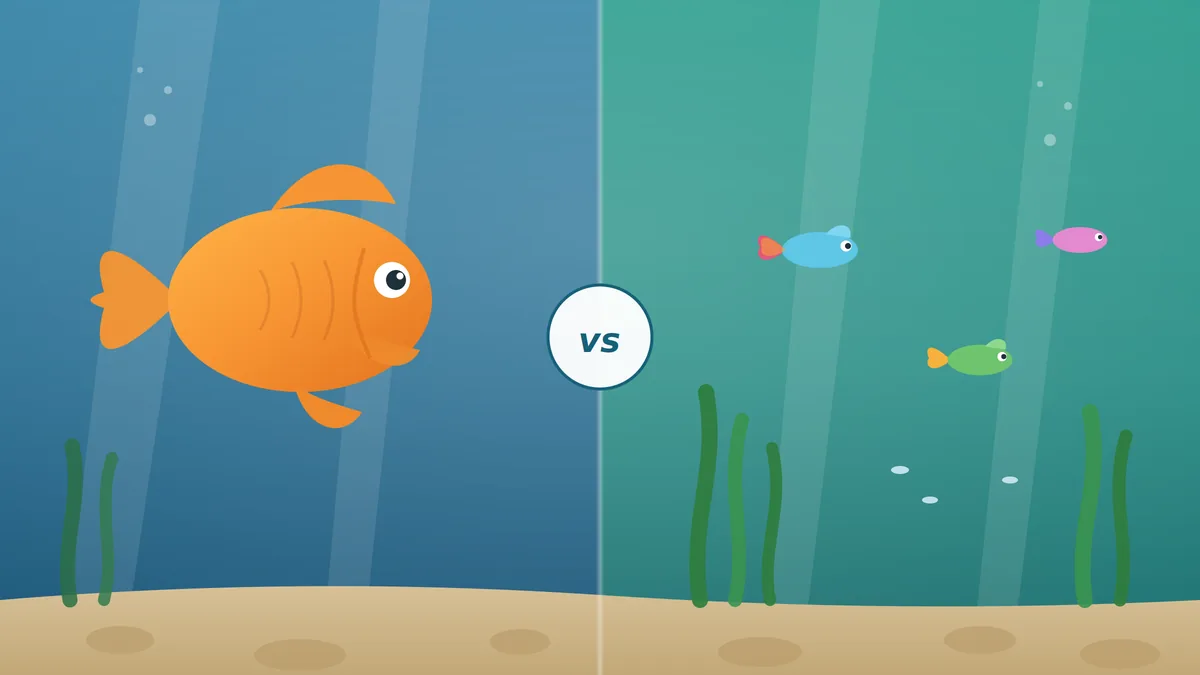
Quick answer: Goldfish and guppies have some overlap in published temperature ranges, but they are generally not recommended as long-term tank mates. Goldfish prefer cooler conditions, produce a heavier bioload, and can grow large enough to eat guppies — especially fry. For most keepers, separate species-appropriate tanks are the safer and simpler choice.
Can Goldfish and Guppies Live Together?
It is a popular question, and the honest answer is: usually not for the long term. It is not that the two fish instantly harm each other — plenty of people have kept them in the same tank for a while. The problem is that goldfish and guppies want different things from their environment, and one of them (the guppy) is small enough to become a snack.
Major care guides say so directly. PetMD’s guppy care sheet states plainly that “guppies should not be housed with goldfish,” because “goldfish prefer cooler water temperatures and can grow large enough to eat guppies.” That single sentence captures the two biggest issues, and the rest of this guide unpacks them so you can decide what is right for your tank.
Will Goldfish Eat Guppies?
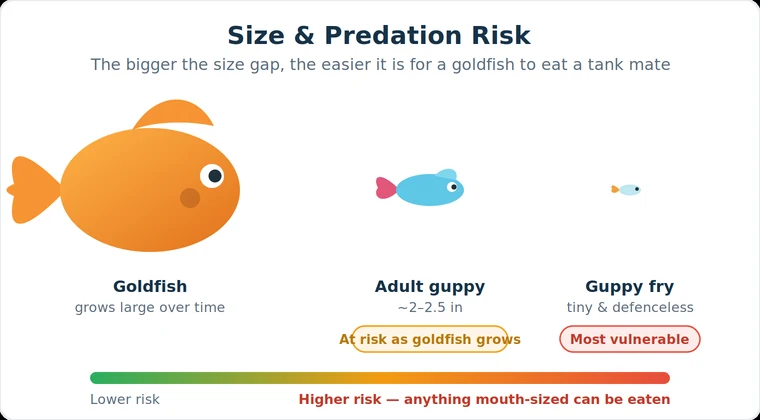
This is the strongest reason to keep them apart. Goldfish are opportunistic omnivores — they graze, scavenge, and will eat more or less anything that fits in their mouth. Guppies are small (usually around 2–2.5 inches), and their fry are tiny, so they fit easily. In fact, the USGS species profile for goldfish notes that fish eggs and fry form part of their natural diet, so newborn guppies are exactly the kind of food a goldfish will take.
You do not need an aggressive goldfish for this to happen. A goldfish does not chase guppies down like a predator; it simply hoovers up whatever passes by, and a curious guppy or a cloud of newborn fry is fair game. Because guppies are prolific livebearers, any fry born in a shared tank are very likely to disappear quickly.
The risk also grows over time. Goldfish start small in the store but can become much larger fish, and their adult size varies a lot by variety and how they are kept. As the size gap widens, even adult guppies can become mouth-sized. If you want the full picture on goldfish and their tank mates, see our guide on whether goldfish eat other fish.
The Temperature Difference
The second issue is comfort, not survival. Goldfish are cool-water (subtropical) fish, while guppies are tropical fish that are usually kept warmer. Their published care ranges do overlap a little, but their preferred conditions sit at opposite ends of that overlap.
| What they need | Goldfish | Guppy |
|---|---|---|
| Water type | Cooler / subtropical | Warmer / tropical |
| Typical care-guide temperature | ~65–75°F (18–24°C) | ~72–82°F (22–28°C) |
| Adult size | Much larger; varies greatly by variety | Usually around 2–2.5″ |
| Waste / bioload | Relatively heavy | Much lighter per fish |
| Toward the other | May swallow fish or fry small enough to fit | Vulnerable, especially fry |
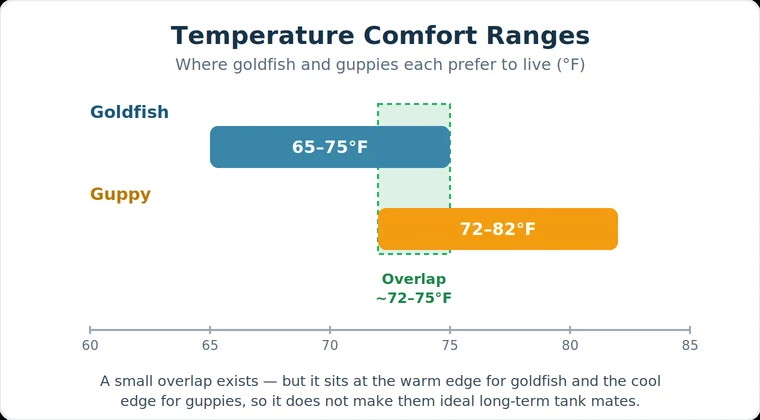
Sources differ on the exact numbers — some list guppies as low as the low 60s°F for short-term tolerance, and fancy guppy strains are often kept around 76–78°F — so treat these as general ranges rather than hard limits. The point is not that the two can never share a temperature; it is that any shared setting is a compromise that suits neither fish perfectly, and comfortable fish are healthier fish over the long run.
Waste, Ammonia, and Water Quality
Goldfish create a relatively heavy bioload — for their size they produce a lot of waste — so a shared tank needs enough biological filtration and regular water-quality monitoring to keep up. More waste does not automatically mean an ammonia spike: in a properly cycled aquarium, a mature biofilter should keep ammonia and nitrite under control. What the extra load really does is shrink your margin for error, so overstocking or weak filtration shows up faster.
That is why a mixed goldfish-and-guppy tank should be larger, well-filtered, and fully cycled before it houses either fish. If you are new to how ammonia and nitrite build up (and why a brand-new tank is risky), read our guide to the aquarium nitrogen cycle first.
Tank and Setup Differences
Beyond temperature and predation, the two fish are built for different tanks. Goldfish need space and strong filtration to cope with their waste and their eventual size. Guppies do well in smaller, warm, gently filtered tanks and appreciate plants and hiding spots — the same cover that would help guppy fry survive is exactly what a goldfish tank usually lacks. Trying to satisfy both at once tends to produce a tank that is a mediocre fit for each. For a proper guppy setup, see how many guppies fit in a 10-gallon tank.
When Keeping Them Together Might Work
None of this means every shared tank ends in disaster tomorrow. Under overlapping conditions — a temperature held toward the warm end of the goldfish range, a large and heavily filtered tank, and slower fancy goldfish rather than fast common or comet types — some keepers do maintain both together, at least for a while.
But those conditions reduce the risk; they do not remove it. The size and predation gap is still there, the water-quality demands still pull in opposite directions, and any guppy fry are still likely to be eaten. So a shared tank is best thought of as a short-term or temporary arrangement, not a recommended long-term community. If your goal is thriving fish rather than fish that merely cope, separate tanks win.
Want a visual overview of goldfish temperature, filtration, and tank-mate needs? This Aquarium Co-Op care guide covers those basics clearly.
Video: Fancy Goldfish Care Guide — Aquarium Co-Op. Supplementary educational material on goldfish care; it is not the basis for the goldfish–guppy compatibility verdict above. See also Aquarium Co-Op’s How to Care for Guppy Fish.
Better Tank Mates
Both fish have much more suitable companions when you match temperature, adult size, and temperament:
- For goldfish: other goldfish of a similar variety are the simplest, safest choice. A few cool-water community fish are commonly kept with them — for example, white cloud mountain minnows and zebra danios — because they tolerate the same cooler temperatures. Whatever you choose, match adult sizes so nobody becomes a meal.
- For guppies: a peaceful tropical community suits them best — other small, calm livebearers and community fish that share the guppy’s temperature range and won’t nip fins or eat fry.
Treat these as starting points, not a blanket list: within any group, individual species still differ in size, temperature range, and temperament, so check each fish before adding it. When those needs line up, the tank runs itself; when they don’t, you spend your time managing problems.
Frequently Asked Questions
Do goldfish and guppies get along?
They are not naturally aggressive toward each other, but they are not a good match. Goldfish prefer cooler water, make more mess, and can eat guppies as the size gap grows, so they are generally not recommended as long-term tank mates.
Will goldfish eat guppies?
They can. Goldfish are opportunistic omnivores and will eat anything that fits in their mouth. Guppy fry are almost always eaten in a shared tank, and larger goldfish can take small adult guppies too.
Can goldfish and guppies live in the same temperature?
Their care ranges overlap slightly around the low-to-mid 70s°F, so a shared temperature is possible. But it sits at the warm edge for goldfish and the cool edge for guppies, so it suits neither perfectly.
Can baby guppies (fry) survive with goldfish?
Very rarely. Fry are tiny and have no way to escape a hungry goldfish. If you want guppy fry to survive, raise them in a separate tank or a well-planted, goldfish-free setup.
What fish can live with goldfish?
Other goldfish of a similar variety are the easiest choice. Any companion should tolerate cooler water and be too large to be eaten and too gentle to nip a goldfish’s fins.
What fish can live with guppies?
Peaceful tropical community fish and other small, calm livebearers that enjoy the same warm water and won’t harass them or hunt their fry.
Sources & References
- PetMD — Guppy Care Sheet (states guppies should not be housed with goldfish; guppy temperature 72–82°F).
- PetMD — Goldfish Care Sheet (goldfish temperature and care).
- USGS — Goldfish (Carassius auratus) Species Profile (documents fish eggs and fry in the goldfish diet).
- Aquarium Co-Op — Guppy Care Guide (guppy warm-water preference).
What should I do?
- Already keeping both together? Watch temperature, ammonia and nitrite, the size difference, any chasing or injuries, and whether guppy fry go missing.
- Goldfish getting much larger than the guppies? Move them into separate tanks before the size gap becomes a problem.
- Want guppy fry to survive? Raise them well away from goldfish — in a separate or heavily planted, goldfish-free tank.
- Setting up a new tank? Give each species its own appropriate setup; it is simpler and safer than compromising for both.
The Bottom Line
Goldfish and guppies can share water for a while, but they are a compromise, not a match. Goldfish want it cooler, make more mess, and grow big enough to eat guppies and their fry. If you love both, the happiest outcome is two tanks — a cool, roomy one for the goldfish and a warm, planted one for the guppies — where each fish gets exactly what it needs.




[…] Fact: Goldfish are opportunistic omnivores, not typical fish-hunting predators. They can consume fish eggs, fry, very small fish, and sometimes dead or weakened tankmates. That size-and-opportunity risk is exactly why small tank mates such as guppies need careful thought — see whether goldfish and guppies can live together. […]
[…] Because guppies need steady warmth, they are not an ideal match for cool-water goldfish — see our guide on keeping guppies with goldfish. […]